Why we build evaluation into the handoff layer, not after it

We've recently started seeing a recurring failure pattern in a few multi-agent deployments. A financial team uses several agents to split a reconciliation job: the first pulls data, a second normalizes it, a third flags edge cases, and the last writes the final report. The workflow passes tests.
Then, in production, the flagging agent silently starts to miss one particular edge case after the data format drifts and its context doesn't get updated. The report continues to be published weekly, but now minus the check it was designed for.
This doesn't appear to be an isolated issue with one team usage of multi-agent deployments has more than tripled in less than four months, per a 2026 report from Databricks. No doubt this has outpaced many teams' capacity for evaluating these systems.
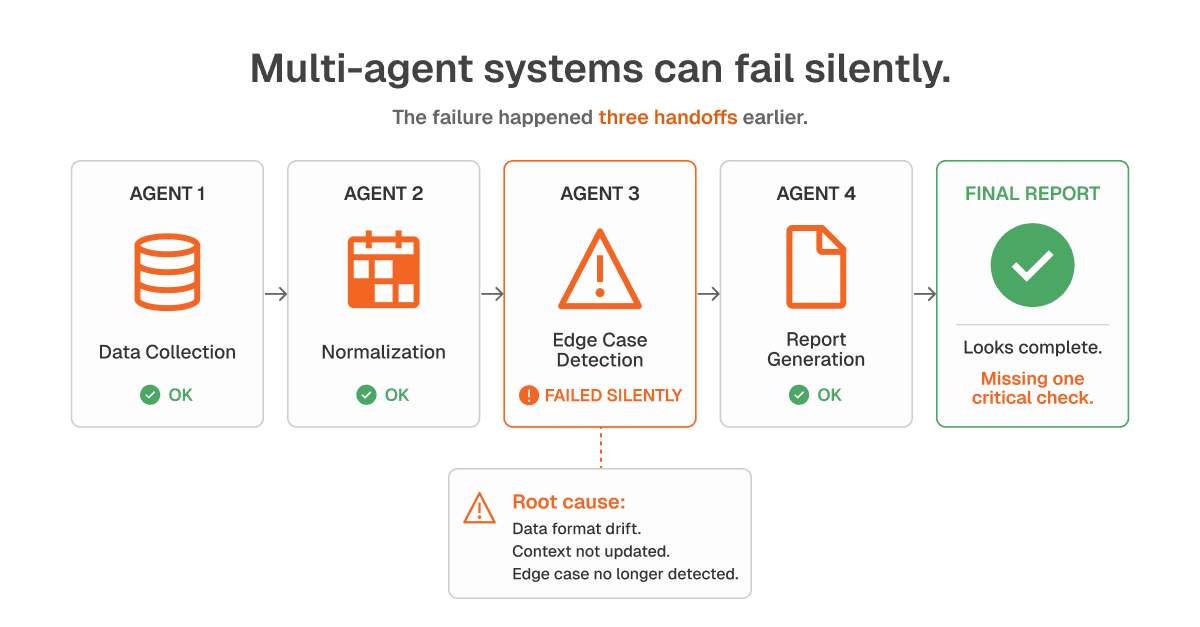
The way they fail is also different from single agents. With a single agent, when it makes a mistake, you typically catch it on review the output looks wrong, and that's the signal. Multi-agent deployments don't give you that. A supervisor agent can hand back something that looks complete, while one of the inner steps failed three handoffs upstream, with no indication anywhere in the final output.
According to an OutSystems 2026 report, nearly all 94% of enterprises are worried that agent sprawl is increasing risk, although 96% were already using agents in production anyway. These organizations aren't reckless. They simply deployed at a pace that made it difficult to keep tabs on everything they'd built.
The data on this is striking: companies with evaluation tools deploy six times more AI projects into production than those without. With governance tooling added on top of that, it's over twelve times more.
This isn't a model limitation. It points to whether organizations had a mechanism for confirming the systems they put in place continued to deliver on their purpose.
In a multi-agent environment, evaluations can't be a one-and-done ritual before launch. Every handoff in the system needs its own checks, so drift gets caught at step two not three months later, when a customer finds it. This is why, at Trace, we've decided to put evaluations directly into the handoff layer rather than after the fact. We've seen too many teams discover drift only once their system falls off a cliff, having done something incorrectly for weeks, sometimes months.